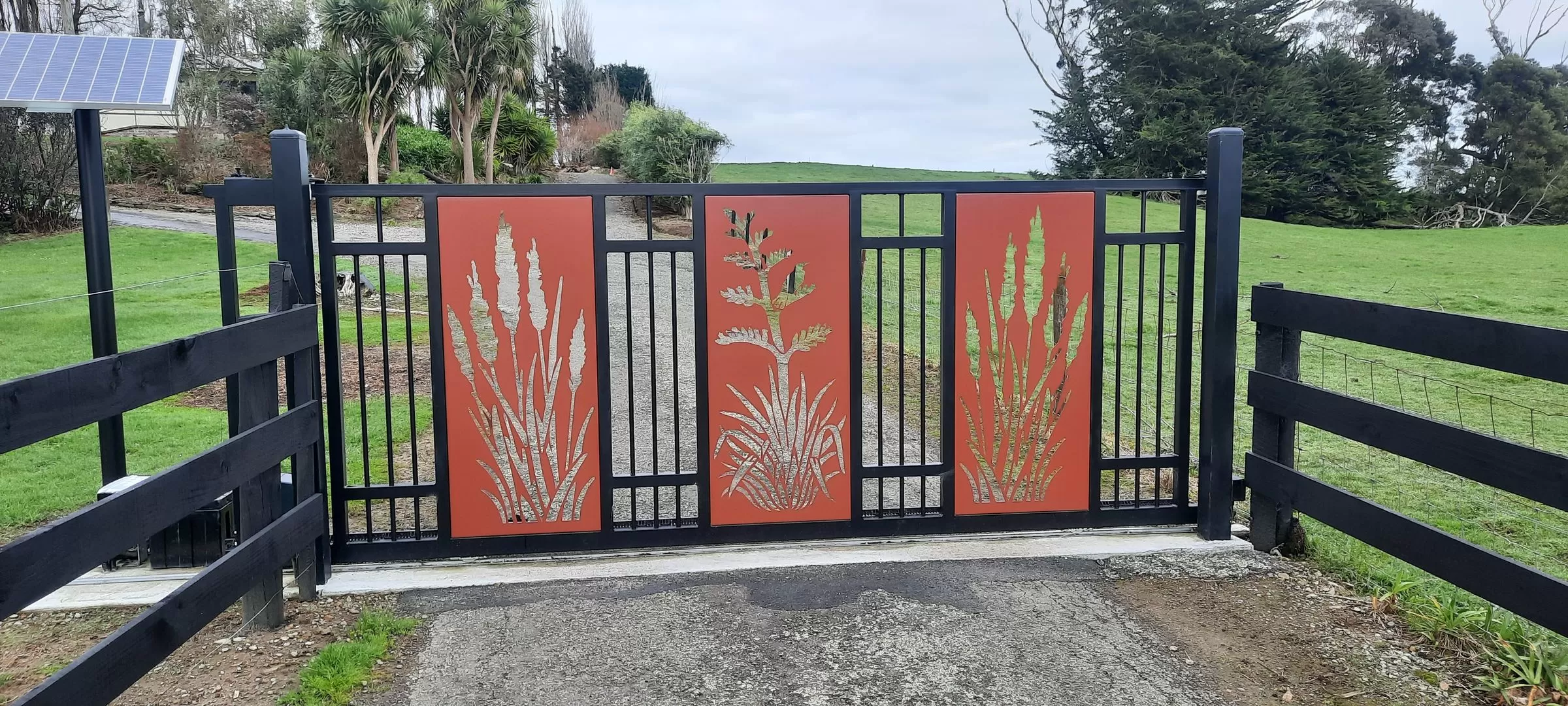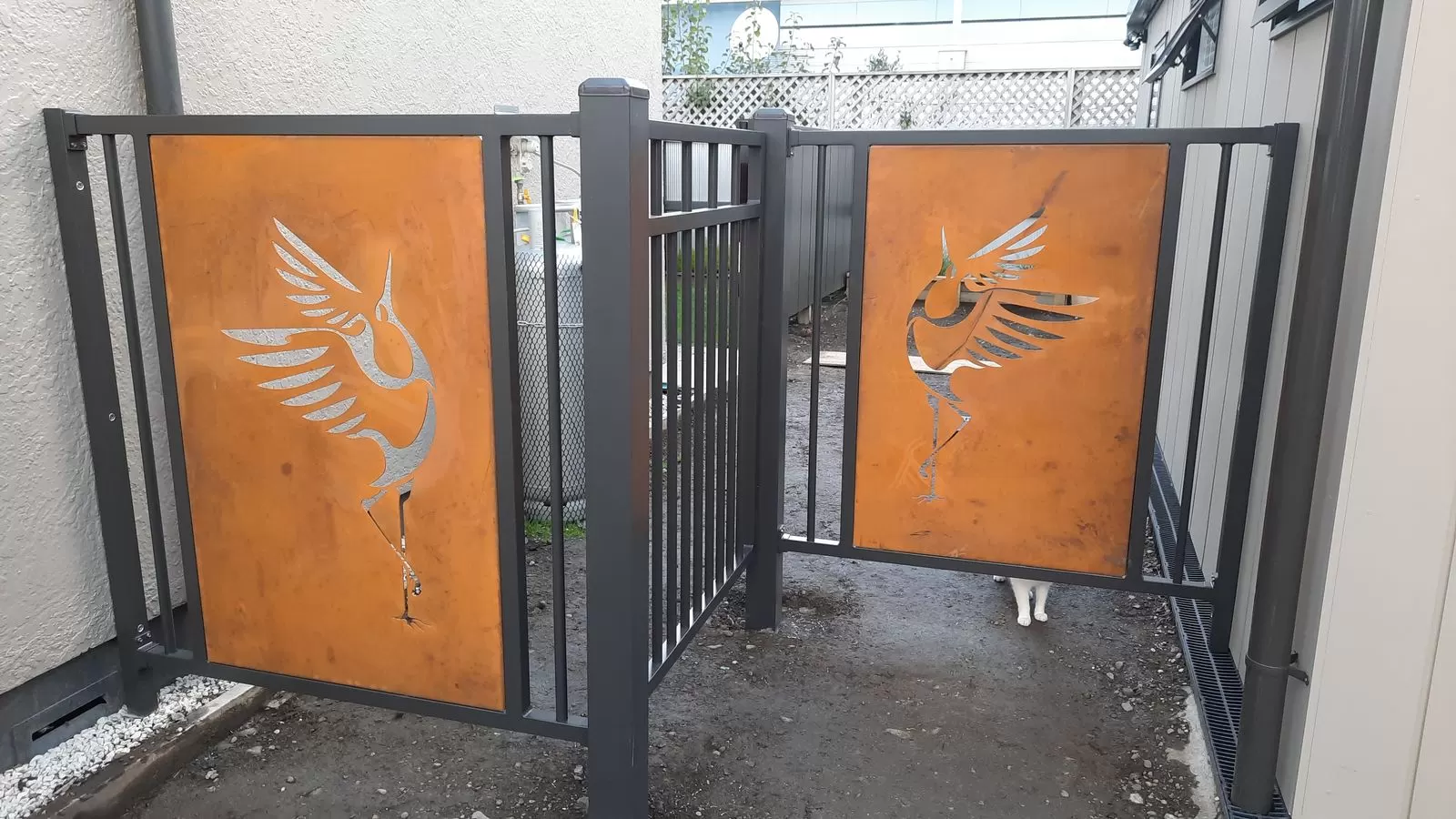
Corten steel has that warm orange-brown colour that looks great against charcoal and black. Jules uses laser-cut Corten panels in gates, fences and screens, set into powder-coated aluminium frames. Before you choose it, here’s how the material works and where it suits.
What is Corten steel?
Corten is a weathering steel. It contains small amounts of alloying elements, with copper the most important, that change the way it rusts (Wikipedia). Ordinary steel gets loose, flaky rust that keeps eating into the metal. Weathering steel forms a dense rust layer that sticks to the surface and slows further corrosion. HERA, the New Zealand heavy engineering research association, describes it as a barrier that impedes further access of oxygen and moisture.
The name comes from COR-TEN, which U.S. Steel introduced in 1933. It stands for corrosion resistance and tensile strength. In New Zealand, “Corten” is now used loosely for weathering steel in general.
How the rust layer forms
The protective layer, often called the patina, builds up as the steel goes through repeated cycles of getting wet and drying out (HERA). New Corten looks like ordinary grey steel at first, turns orange once it’s been rained on, then darkens to a deeper brown as the patina matures. Sources give different timeframes for the patina, from about six months to a few years, because it depends so much on your local weather.
Corten needs those dry spells. If it stays damp, for example where soil, leaves or plants sit against it, the patina can’t settle and the steel keeps corroding (American Galvanizers Association).
Is Corten a good idea near the coast?
This is the big question for coastal Horowhenua and Kāpiti homes. Salt in the air gets in the way of the protective layer. HERA’s design guidance explains that airborne sea salt, especially on sheltered surfaces that rain doesn’t wash, can delay or even stop the patina forming. The steel then keeps corroding at a rate similar to ordinary steel.
For structures like bridges, the same guide says weathering steel can generally be used more than 2 km from the open coast. In some places the safe distance can be as much as 40 km, depending on wind, surf and terrain.
A decorative panel in a gate isn’t a bridge, and the risk is mostly to looks rather than strength: more rust, more flaking and more staining. If you live right by the beach, ask Jules about a laser-cut aluminium panel instead. It can be cut in the same kinds of designs and powder coated, so you keep the feature without the salt problem.
Will Corten stain my paving?
It can. Rain washes rust off the surface, and that runoff marks whatever is underneath. HERA notes that concrete, stone, wood, galvanised steel and unglazed brick are difficult to clean once stained. Wikipedia makes the same point: staining can be avoided if water doesn’t drain from the steel onto surfaces where it would show. A couple of simple ways to plan for it:
- place panels so runoff falls onto garden beds, gravel or bark rather than pale concrete
- keep Corten away from surfaces you want to stay spotless, such as a light-coloured patio
Corten in gates, fences and screens
In a gate, Corten works best as an infill panel in a powder-coated aluminium frame. The frame stays light and rust-free, and the panel brings the colour and the design. Jules has made gates, fence panels and screens with Corten tūī, flax, toetoe and birds-in-flight designs, and a sliding gate with a Corten tree of life. A skilled designer he works with can also turn your own photo or drawing into a file that can be laser cut.
A rusty panel looks its best against charcoal or black aluminium, where the contrast makes the design stand out. See laser-cut and Corten gates for examples.
Looking after Corten
Corten is low maintenance, which is a big part of its appeal. Keep soil, mulch, leaves and plants off it, and clear any spots where water sits, so it can dry out between showers. That’s about it.
Sources
- Weathering Steel Design Guide for Bridges in Australia, HERA (commissioned by BlueScope)
- Uncoated weathering steel, American Galvanizers Association
- Weathering steel, Wikipedia